
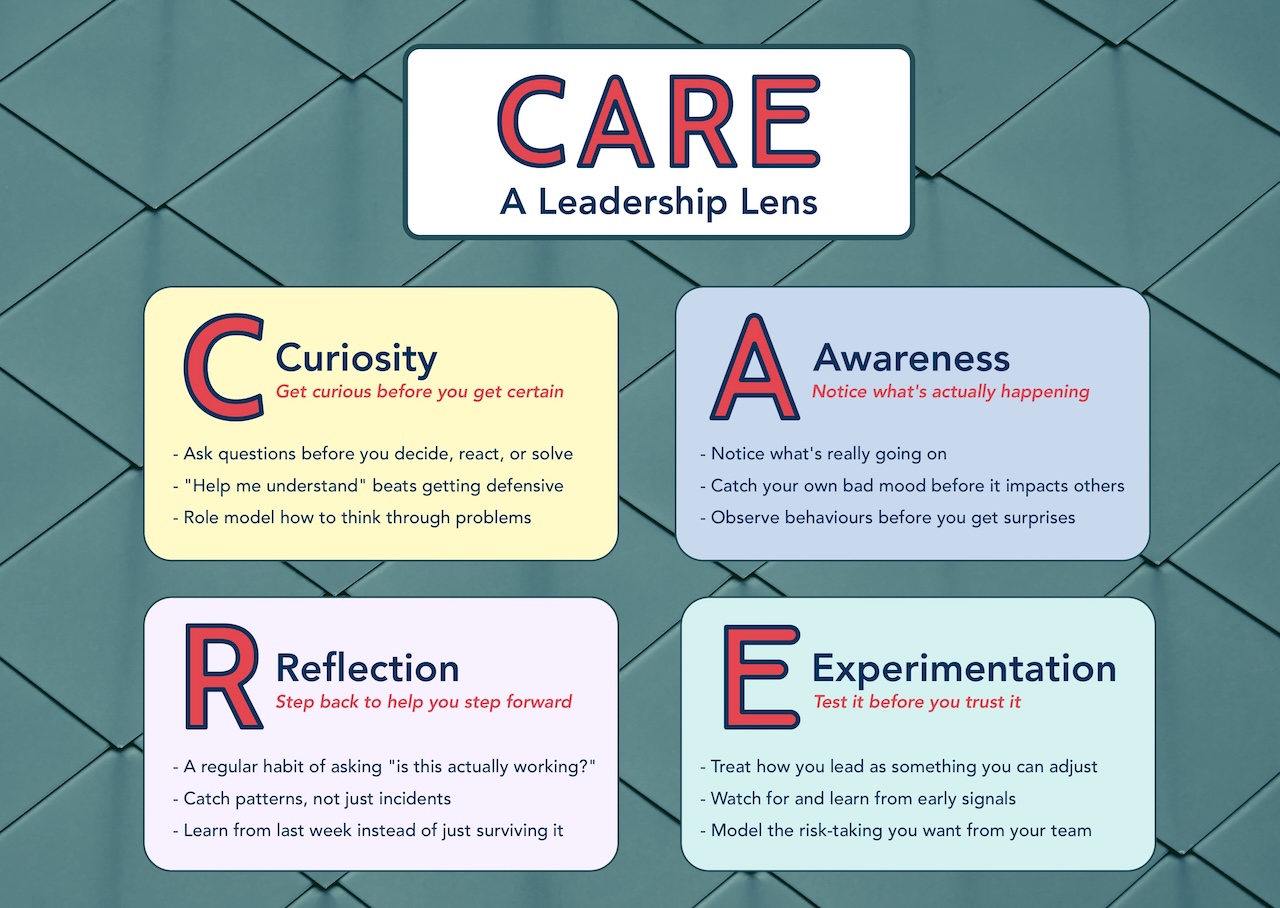
This is what I believe good leadership looks like. I use this lens in leadership roles and coaching tech leaders.
Around 15 years ago, during a phone interview, I was asked: “What are your management strengths?”
I replied, “I care.”
The line went silent for ten seconds.
The silence told me everything. Caring wasn’t a strength they were looking for.
A lot has changed in that time. Caring for your team is now seen as a strength. But for a long time I’ve believed it’s more than that, it’s the foundation everything else builds from.
Not the soft, pushover kind of care. It’s showing you’re invested in the growth and wellbeing of each person in your team. More importantly, it’s whether your team actually believes you’re invested in them.
You can use all the frameworks, 1:1 templates, and coaching questions you like – all useful. But underneath each one is a single question your team is asking about you: does this person care?
Real care is what lets high standards land without crushing someone. It’s why “this isn’t good enough yet” can feel like a vote of confidence and not an attack. Because the trust underneath it is built from caring.
People don’t do their best work for someone who doesn’t care about them. It doesn’t matter how smart your strategy is or how clear your roadmap is. If your team doesn’t feel like you’re invested in them, you’re leading on borrowed time.
With that foundation, here’s what CARE actually spells: Curiosity, Awareness, Reflection, Experimentation.
Curiosity
A director once asked me why my team was going to miss a deadline.
My first instinct was to explain. Defend the team. I stopped myself before I did.
Instead I asked, “Is there a bigger problem I’m not aware of?” Turned out he’d had two other teams miss deadlines that month. He wasn’t checking up on us specifically, he was trying to work out if this was a delivery problem across the org, or just bad luck on one project.
If I started defending my team, I’d have answered a question he wasn’t asking. And, probably wouldn’t have left a good impression of myself.
This happens constantly in leadership. Someone brings you a problem, a query, a bit of pushback, and the instinct under pressure is to skip straight to a response.
Curiosity slows that down. “What’s actually going on here?”
It’s also your best defence against defensiveness. When you’re asked to do something you don’t agree with, “help me understand why” gets you better information than feeling pressured. And it lands very differently with the person asking.
But curiosity only works if it comes from care. Ask “what happened?” to catch someone out is an interrogation. Asking because you actually want to understand is an entirely different conversation.
Fewer decisions made on incomplete information.
Fewer reflexive arguments you didn’t need to have.
The team who experiences you as someone who seeks to understand first is far more open with you in return.
Awareness
When did you last notice something was wrong before someone told you?
The engineer who’s disengaging. The brewing tension between two engineers. The silence in the room where there was once energy.
I’ve been guilty of not noticing. One that sticks in my mind was with mental health signals. I could say how bad I felt when finally realising something had to be done. But worse, it’s how that person felt during that period, not getting the support they needed.
These signals typically go unnoticed until something blows. Then it might even be too late.
Then there’s noticing signs in yourself. Not reading your own state entering a meeting.
The pressure that has been building for weeks. Being short tempered with others because of a mistake you made.
This isn’t about not caring. It’s that noticing hasn’t been a focus, too many other things going on.
Awareness isn’t a personality trait some leaders have and others don’t. It’s closer to a muscle most tech leaders were never asked to build. For years the job was rewarding a different set of skills.
Normally problems show up small, long before becoming an issue. That’s exactly why they get missed.
We watch and spot the obvious signals – someone visibly upset, a deadline visibly at risk. But miss the quiet ones building underneath.
The good news: it’s trainable. It starts with actually looking, on purpose. What’s changed? In your team and in yourself.
Reflection
When did you last finish a hard week and actually think about it, instead of just surviving it?
In my early years as an EM, the answer would have been never. Relieved to get through a tough week and start the weekend. Then Monday arrives, into the same cycle, last week was a thing of the past.
It seemed like good resilience. Not letting things get to me. But when similar patterns started appearing, I realised it was more like avoidance.
The same difficult conversation kept showing up with different people. Not realising delegation opportunities to help others grow until too late. Recognition for great work was being missed. Communication gaps kept showing up causing confusion and delays.
Reflection isn’t simply replaying a bad moment in your head (I was already good at that!)
This rarely changes anything because it never gets past “I should’ve handled that better.”
Real reflection is different. It’s space to see patterns and to zoom out. It’s time to grow as a leader. Reflection is the time you create because you actually care about getting better.
Reflect on your team: what should be celebrated? What small improvements can be made? Any communication to share?
Reflect on yourself: what interactions could you have handled differently? Where can you delegate more? What do you need for your wellbeing?
The patterns don’t go away because you’re too busy to look at them. You just get better at ignoring them.
Experimentation
You can’t grow as a leader without trying things that might not work. That’s the uncomfortable part that many leaders are happy to put off.
Growth isn’t just more reading or more reflecting. It means doing something differently than you did last week, with no guarantee it lands.
I know how easy it is to avoid. I’ve had internal debates about whether to try something different. I can be very creative with excellent delaying excuses.
Trying something new and failing feels like a bigger risk than staying exactly as you are.
Leading my current way has basically worked so why change it?
This is the crux. But, if you actually care about your team, is staying exactly as you are the safe or selfish option?
Care means wanting things to get better for the people you lead. This means trying things out that might not work. It means experimenting.
That doesn’t mean experimenting recklessly. Involve your team, share with your team what you’re trying to do and why. Invite their feedback.
Without finding the courage to experiment, I would never have started a fun new form of recognition that became a monthly favourite. Established an internal tech conference where teams share what they’re working on. Created a leadership forum for tech leaders to learn from each other.
Experimenting means trying things that might not work. None of that happens without risk. Care enough to take it.
Bringing It Together
Four ideas. One thing underneath all of them.
Curiosity – asking “is there a bigger problem I’m not aware of” instead of defending yourself, because you actually want to understand, not just respond.
Awareness – noticing the quiet signals before they turn into someone quitting, because you’re paying attention to people, not just output.
Reflection – creating time to see patterns and zoom out, because you care enough about getting better to actually look.
Experimentation – trying things that might not work, because you care enough about your team’s environment to want it to be better, not just comfortable.
This isn’t another framework to be adopted. It’s the lens through what I believe good leadership looks like. Shaped over many years of learning from my mistakes.
Get the foundation of care right, the 4 areas naturally follow.
Leave a Reply